


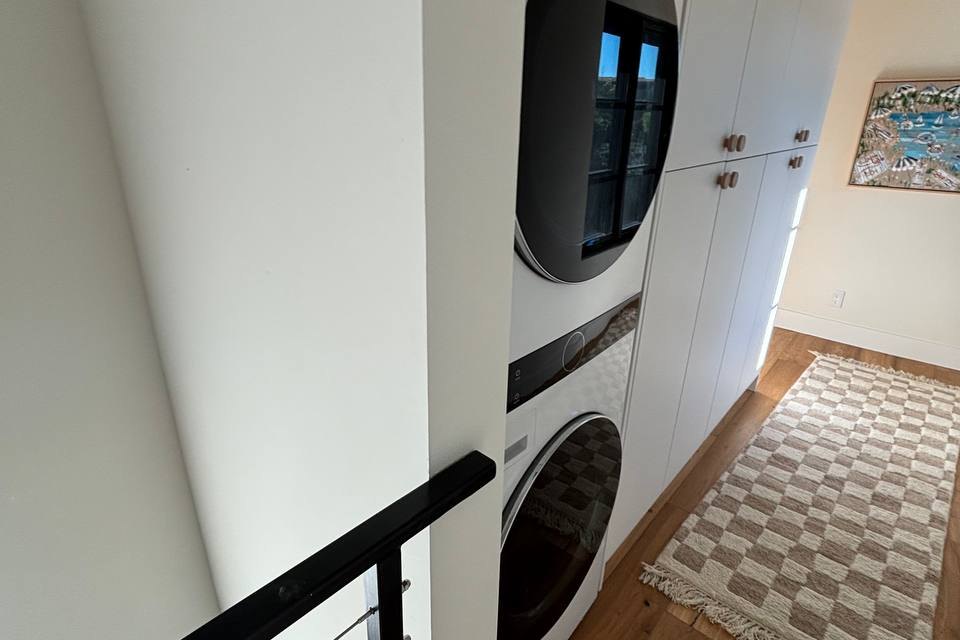
Nobody photographs their laundry room, which is exactly why it stays bad for twenty years. It is also a room most households use several times a week, and it is one of the cheapest rooms in the house to genuinely transform because it is small, it has no expensive fixtures and it does not need to be beautiful - it needs to work.
What we build into a laundry room
A counter over front-load machines, which turns the room into a folding station and is the single change most people say they should have done years ago. Upper and lower cabinetry, a tall broom and cleaning cupboard, and a pull-out hamper. A utility sink with a proper faucet for hand washing and soaking. A hanging rod or drying rack. Durable, water-tolerant flooring, tiled or luxury vinyl, with a floor drain or a drain pan under the washer plumbed to a drain - which is the detail that prevents a burst hose becoming a claim. Recessed or bright task lighting instead of a single bulb. Correct outlets, a dedicated circuit where required, and a recessed washer box so the machines can sit tight to the wall.
The technical items that matter more than the cabinets
Dryer venting done properly - rigid duct, the shortest practical run, a real exterior termination, and no flexible foil coil crushed behind the machine. This is both a performance issue and a genuine fire risk, and it is wrong in an enormous number of Los Angeles homes. Braided steel supply hoses with a single-lever shut-off, because rubber washer hoses are one of the most common causes of catastrophic water damage. A drain pan and a leak sensor for any laundry on an upper floor or over finished space. Gas line and shut-off valve work for gas dryers, leak tested. Ventilation or an exhaust fan in a closed laundry closet so humidity is not sitting in the wall.
Stacked and closet conversions
Converting a side-by-side laundry to a stacked pair frees a surprising amount of space and often lets us add a full-height cupboard or a sink. Converting a hallway closet into a laundry closet is a common request and entirely feasible where a drain, vent and supply can be reached - we assess the plumbing route honestly before you plan around it. We also relocate laundry from a garage into the house where the plumbing allows.
Mudrooms and entry drops
A bench with shoe storage below, hooks at adult and child height, cubbies or lockers, a durable wainscot or panel on the wall that will take abuse, a boot tray or tiled floor area, and a drop zone for keys, post and chargers. Built on site by finish carpenters and scribed to your walls, which in a Los Angeles house are not square. This is the highest-impact small carpentry project we do for families, and it takes about a week.
What is included in this service
- Design layout for the actual space, including stacked conversions
- Cabinetry - uppers, base, tall utility cupboard and pull-out hamper
- Folding counter over front-load machines with proper support
- Utility sink, faucet and drain installation
- Hanging rod, drying rack and ironing storage
- Water-tolerant tile or luxury vinyl flooring installation
- Drain pan under the washer, plumbed to a drain, plus leak sensor
- Recessed washer box so machines sit tight to the wall
- Braided steel supply hoses with single-lever shut-off valve
- Rigid dryer duct with a short run and proper exterior termination
- Gas line and shut-off valve work for gas dryers, leak tested
- Dedicated circuits, outlets and correct receptacles
- Exhaust or make-up ventilation for enclosed laundry closets
- Task lighting and switching upgrades
- Mudroom bench, cubbies, lockers and hook rails built on site
- Durable wainscot, board and batten or panel wall treatment
- Paint and finish throughout
Frequently asked questions
Can I convert a hall closet into a laundry closet?
Often yes, and it is one of the better small projects there is. The deciding factors are whether we can reach a drain and vent stack, get supply lines in, provide a dedicated circuit and vent the dryer to the exterior. We assess all four before quoting, because a closet that cannot be vented is not a laundry closet.
How much does a laundry room remodel cost?
A cabinetry, counter, flooring, lighting and venting package in an existing laundry room typically runs $4,500 to $12,000 depending on cabinet quality and whether a sink and plumbing changes are involved. A mudroom bench and locker build-out typically runs $2,800 to $7,500.
Is my dryer vent actually a problem?
If it is flexible foil or plastic, or it is crushed behind the machine, or the run is long with multiple bends, or it terminates in a garage, attic or crawl space - yes. Lint accumulation in those conditions is a recognised fire cause, and it also makes your dryer take twice as long, which you are paying for every load.
Do I need a drain pan under my washer?
On a slab in a garage, it is optional. Above finished space, over a downstairs room, or on a second floor, it is one of the cheapest pieces of insurance you can buy - a pan plumbed to a drain plus a leak sensor. We install them as standard on upper-floor laundry.
Can you move my laundry from the garage into the house?
Frequently yes, given a viable plumbing route, an exterior wall or accessible chase for the dryer vent, and space for a suitable enclosure. We look at the drain path first, because that is what determines whether it is a straightforward project or a large one.
Other services our Los Angeles crews handle


