


A two car garage is roughly four hundred square feet. In Los Angeles that is a meaningful amount of the property you are paying for, and in most homes it is a dark, dusty, unfinished room used as a warehouse for things nobody has opened in six years. Making it a usable, finished space is one of the least expensive per-square-foot improvements available.
To be clear about scope: this is renovation of your existing garage as a garage, workshop, gym or storage space. We are not doing garage conversions to living units or accessory dwelling units - that is a different project with a different permitting path, and it is not what we offer here.
The floor
The floor is what makes a garage feel finished or unfinished, and coating it is the highest-impact single item. We do it properly: diamond grinding rather than acid etching, moisture testing, crack and spall repair, then a professional epoxy or polyaspartic system with a broadcast flake and a UV-stable topcoat. A ground and correctly primed floor is why a coating lasts a decade instead of peeling off in sheets with your tyres, which is what happens with every one-day kit sold in a box.
Walls, ceiling and light
Bare studs and exposed framing get drywalled, taped, textured and painted in a light durable finish - and where the wall separates the garage from the house or from a room above, we make sure the fire separation is correct, because that assembly matters and it is frequently compromised by earlier work. Lighting goes from one bare bulb to LED strips or high-bay fixtures at real light levels, on a switch that makes sense. We add outlets where you actually need them, a dedicated circuit for a compressor, freezer or EV charger, and a ceiling outlet for a door opener.
Storage that uses the volume, not the floor
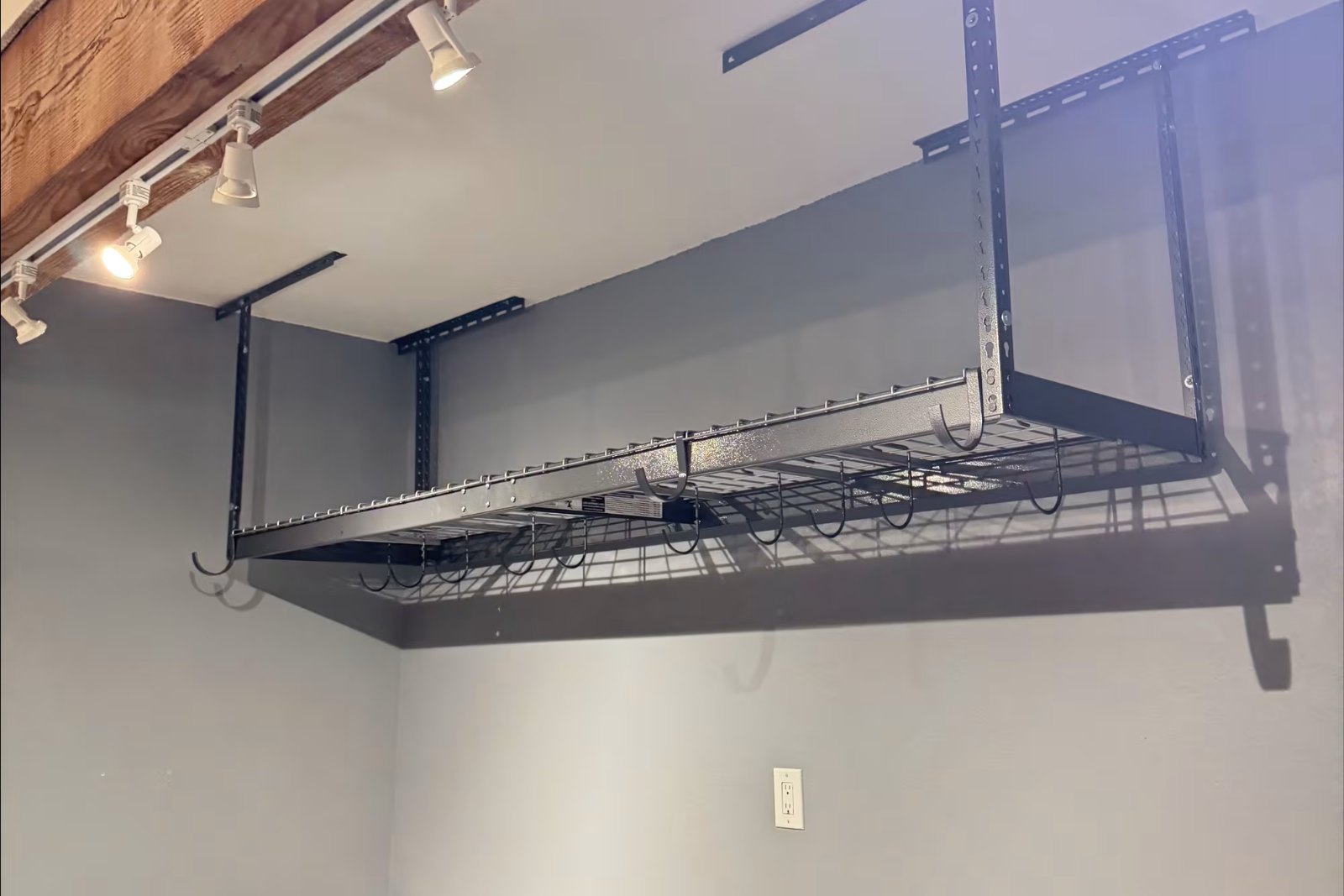
Overhead platforms anchored into ceiling framing for seasonal storage. Wall-mounted track, slatwall or french cleat systems so tools hang instead of stacking. Adjustable heavy-duty shelving anchored into studs. A workbench with a hardwood or laminate top, power at bench height and task lighting. Bike, ladder and sports equipment hangers. Cabinets with doors where you want it to look tidy rather than industrial. Everything anchored into framing - garage storage failures are almost always anchoring failures, and a loaded overhead rack coming down is a serious event.
Comfort and the rest
Insulation to the ceiling and the house-side wall, plus an insulated garage door, makes a genuine difference to the room above and to working in there in August. Ventilation or an exhaust fan for a workshop. Rodent exclusion at the door sweep, wall penetrations and the corners where they get in. Garage door repair, tune-up and opener replacement, which we also do as standalone work. Utility sink where plumbing is reachable.
Timeline and value
A floor coating alone is two to three days including cure time. A full refresh with drywall, paint, lighting, power and storage is typically five to ten days. It is a project you can do in stages, and if budget is limited we will tell you the order that gives you the most usable space soonest - which is almost always floor, light, then vertical storage.
What is included in this service
- Diamond grinding, moisture testing and crack and spall repair
- Professional epoxy or polyaspartic floor coating with flake and topcoat
- Drywall, tape, texture and paint on walls and ceiling
- Fire separation assembly verification and correction
- LED strip and high-bay lighting with sensible switching
- Additional outlets, dedicated circuits and ceiling receptacles
- EV charger circuit rough-in where the panel allows
- Overhead storage platforms anchored into ceiling framing
- Slatwall, track and french cleat wall organisation systems
- Heavy-duty adjustable shelving anchored into studs
- Workbench with durable top, bench-height power and task lighting
- Bike, ladder and equipment hangers
- Cabinets and closed storage where a tidy look is wanted
- Ceiling and house-side wall insulation, insulated garage door options
- Exhaust ventilation for workshop use
- Rodent exclusion at door sweeps, penetrations and corners
- Utility sink installation where plumbing is reachable
- Garage door repair, tune-up and opener replacement
Frequently asked questions
Are DIY epoxy floor kits worth it?
No, and the reason is preparation, not the product. Those kits rely on acid etching, which does not open the concrete profile reliably, and they include no moisture testing. Coatings fail by delaminating, usually where hot tyres sit. Diamond grinding and moisture testing are what make a coating last, and they need equipment.
How much does a garage floor coating cost?
A two car garage typically runs $2,400 to $4,200 depending on the system and the amount of crack and spall repair needed. Polyaspartic costs more than epoxy and cures faster, which means less time out of use, and it holds colour better under UV.
Can you convert my garage into a living space or an ADU?
No. That is not work we take on. What we do here is renovate the garage as a garage, workshop, gym or storage space - floor, walls, lighting, power, insulation and storage.
Will overhead storage racks hold in my ceiling?
Only if they are anchored into ceiling joists or trusses with correct fasteners and the load is within the framing capacity. We locate framing, verify member sizes and install accordingly. We have taken down plenty of racks that were lag screwed into drywall and were one box of tiles away from failing.
Can I do this in stages?
Yes, and we often recommend it. The order that gives you the most usable space fastest is floor coating first, then lighting and power, then vertical and overhead storage, then drywall and paint. We will scope it so each stage stands alone and nothing has to be redone.
Other services our Los Angeles crews handle


