


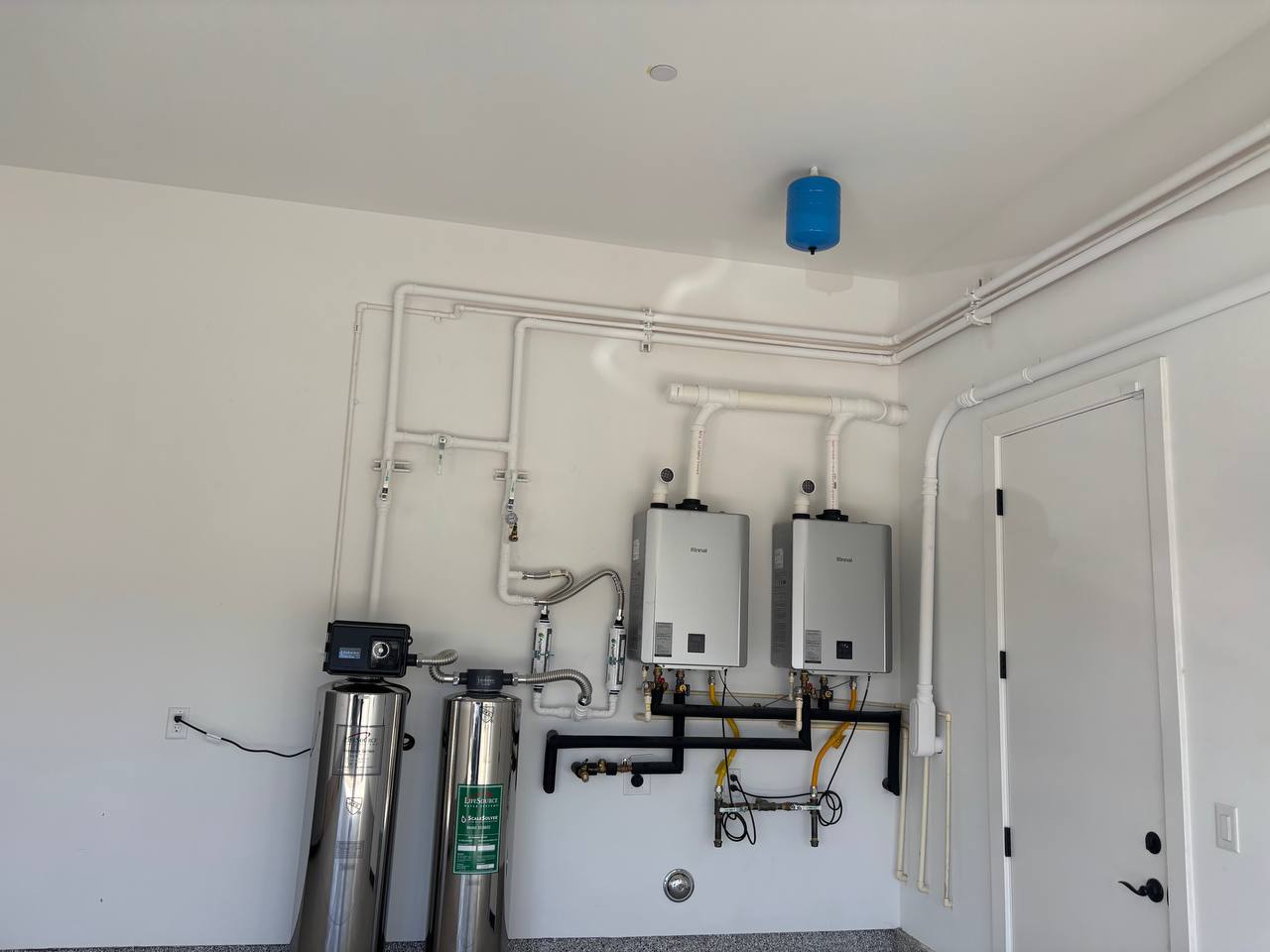

Replacing a single ageing storage tank heater in a 2003 Calabasas house with two linked tankless units and a whole-house water softener, plus a recirculation loop for the far bathrooms. The client asked for a bigger water heater. The real problems were recovery rate and water hardness, which are two different things, and neither is solved by a bigger tank. The softener sits upstream of the heaters so the heat exchangers do not scale, and both units have isolation and service valves so either can be serviced without shutting hot water off to the house.
A 2003 house in Calabasas, roughly 4,200 square feet, five bathrooms, with a single ageing storage tank heater in the utility room off the garage. The house was built for a family half the size of the one living in it now.
The complaint was simple and it is the most common one we hear in a big house: the last person to shower gets cold water, and the water leaves white marks on the glass and the fixtures. He asked for a bigger water heater.
Two separate problems that people usually treat as one. The cold shower was a recovery problem, not a capacity problem, and a bigger tank would only have moved the failure point later in the morning. The white marks were hardness, which no water heater fixes. We also found the existing gas line and the venting had been sized for the original single tank, and the run to the far bathrooms was long enough that the wait for hot water was pushing gallons of clean water down the drain every morning.
Two linked units instead of one large one, and the softener upstream rather than downstream. A single big tankless unit is cheaper to install and it is what most quotes will show you. The problem is that it is a single point of failure in a house with five bathrooms: when it goes down the whole house has no hot water, and when demand is low it short-cycles. A linked pair gives redundancy, runs each unit in its efficient band, and lets us service one while the family still showers. Putting the softener upstream costs a little more pipework and adds years to the heat exchangers, because in this part of Los Angeles scale is what actually kills tankless units, not age.
Isolation and service valves on both units and a labelled manifold. It is unglamorous and it means the next person who works on this system, whether it is us or someone else, can do it in an hour instead of a day. Photograph a mechanical room and you can tell immediately whether the installer was thinking about the install or about the next ten years.