


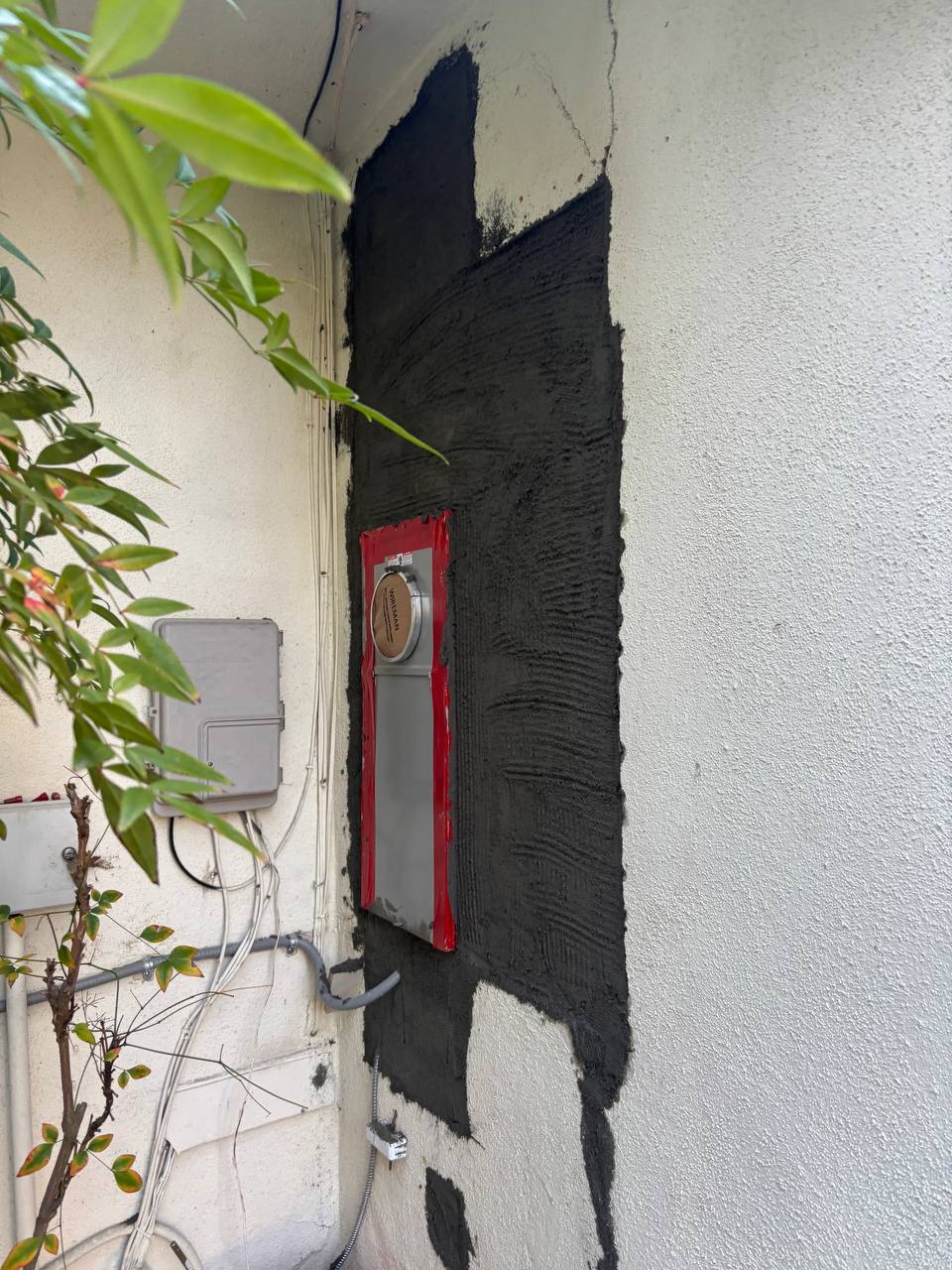

Restoring the side elevation of a 1972 Westwood home after an electrical panel upgrade. The client asked for a stucco patch and paint. What the wall actually needed was the cause of the cracking removed. The panel had been face-mounted into the stucco skin with the wrong fasteners and the penetrations sealed with caulk rather than flashed, so the lath behind it had been rusting for years. We opened back to sound material, replaced the corroded lath, lapped the weather barrier correctly, re-anchored into structure with fasteners selected for the substrate, then rebuilt the stucco as scratch, brown and finish coat with proper cure time, and painted to the technology with a primer and three coats.
A 1972 single-family home in Westwood with traditional three-coat stucco over wire lath. The main electrical panel and the sub-panel sit on the side elevation, half hidden behind mature planting, which is exactly where nobody looks and where water quietly does its work.
The panel was being upgraded and the client asked us to make good the wall afterwards. In his words, patch the stucco and paint it so you cannot see where the box was.
The previous work around the panel had not been done to any technology. The box had been face-mounted onto the finished stucco with the wrong fasteners, straight into the stucco skin rather than into structure behind it, and the penetrations had been sealed with a bead of caulk instead of being properly flashed. The stucco around the openings had cracked in a radiating pattern from the fixings, which is the signature of a fastener carrying load in a material that cannot carry it. Behind the panel the lath was rusting where water had been getting in for years. Patching that wall and painting it would have hidden a live problem.
Re-anchoring the panel into structure with correctly selected fasteners rather than reusing the existing holes. It is invisible in every photograph of this job. The alternative, which is what the previous contractor did, is to fix into the stucco itself because it is quick and it holds for a while. Stucco is a cladding, not a structural fixing point. A face-mounted box on the wrong fasteners flexes every time someone opens the door, and that flex is what cracked the wall in the first place. Patch the crack without fixing the fixing and you are back in twelve months.
A colour-matched patch always shows. Stucco texture, sheen and the way the surface has weathered are all part of the match, and a fresh patch reads as a bright rectangle at exactly the time of day when the light is raking across the elevation. We rebuild the texture across the transition and take the paint to a natural break in the wall. It costs more paint and it is the only way the repair actually disappears.